For drone manufacturers targeting the EU market, UAS certification is the mandatory conformity assessment process that determines whether a product can legally be placed on sale. It is not the same as a pilot licence or an operator permit – it applies to the product itself, not the person flying it. Understanding what UAS certification requires is the first step toward compliant market access.
What Is UAS Certification?
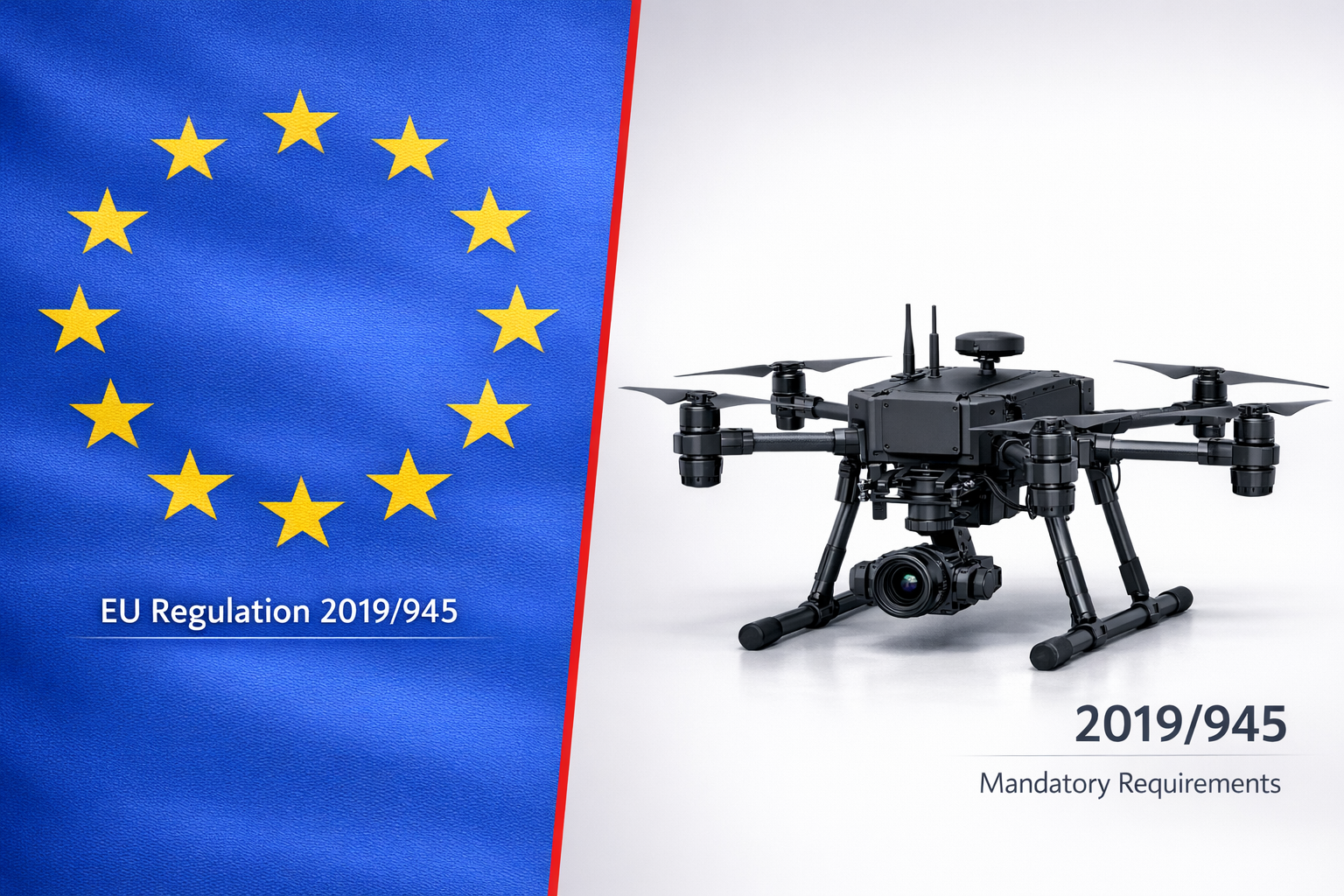
According to Regulation (EU) 2019/945, unmanned aircraft systems (UAS) and remote identification add-ons (DRI Add-on) must comply with the essential safety requirements (ESR) before being placed on the EU market. It also defines the type of UAS whose design, production and maintenance shall be subject to UAS certification.
What is a UAS? The ‘unmanned aircraft system’ (UAS) means an unmanned aircraft and the equipment to control it remotely.
The UAS represent a special market with safety risks and requirements that have to be handled during the whole life path of the products from design through distribution until field operations. The EU drone regulations gave more importance from the viewpoint of product safety and the certification processes. The certification of drones has two major parts: testing according to the relevant standards, and the assessment of the test results and documentation in relation to the requirements of the Regulation.
Another pillar is market surveillance, where the Member States are responsible for ensuring that products placed on the EU market are in conformity with the requirements of the legislation.
Manufacturers shall ensure that their products meet the essential safety requirements. A Notified Body must be involved in the conformity assessment procedures – that body performs conformity assessment activities including testing, assessment, and certification.
UAS Certification vs Licences and Permits
Based on our experience, there are common misunderstandings between UAS certification and pilot licensing. Do drones need a licence? The answer depends on what you mean – and the distinction matters.
UAS certification is a product-level conformity assessment procedure in accordance with Regulation (EU) 2019/945, supported by EN4709 standards. It categorises unmanned aircraft according to classes (C0–C6 and add-ons). This process applies to the manufacturer, not the operator.
Pilot licensing refers to the remote pilot competency requirements under Regulation (EU) 2019/947. This is a person-level requirement – it applies to whoever operates the drone, not to the product itself. These are two separate regulatory frameworks and one does not replace the other.
How UAS Assessment Certification Works
The UAS assessment certification process begins with the manufacturer’s obligation to ensure conformity across design and production. Manufacturers shall draw up the technical documentation and carry out – or have carried out – the relevant conformity assessment procedures.
The conformity assessment covers product compliance with the requirements of UAS Classes (C0, C1, C2, C3, C4, DRI Add-on, C5, C6). The procedures under Regulation (EU) 2019/945 are the following:
Conformity assessment Module A – Internal production control: for unmanned aircraft class 0, class 4, class 5, class 6 and add-ons only. This module does not require a Notified Body.
Conformity assessment Modules B and C – EU-type examination and conformity to type based on internal production control (for all classes).
Conformity assessment Module H – Conformity based on full quality assurance (for all classes).
How to get UAS assessment certification: in the case of Modules B+C and Module H, a Notified Body such as CerTrust must be involved in the procedure. The Notified Body carries out testing, assessment, and UAS certification. A Notified Body is an organisation designated by an EU country to assess the conformity of certain products before being placed on the market, and is listed on the official EU Commission website (NANDO). Our testing and certification process is based on the EN4709 standard series and covers all UAS classes and add-ons.
UAS Operator Certificates and Registration
The UAS operator certificate and UAS certificate of registration are separate from product-level certification. Holding these documents does not mean the drone itself has passed the required conformity assessment – they confirm that the operator meets the competency and administrative requirements to fly, not that the product is market-ready under EU law.
The UAS operator certificate requires remote pilot competency according to Regulation (EU) 2019/947. The Regulation defines three operation categories: ‘open’, ‘specific’ and ‘certified’. The ‘open’ category is divided into subcategories A1, A2 and A3, each with specific competency requirements covering airspace restrictions, aviation regulation, human performance limitations, and related subjects.
After successfully passing the knowledge examination, remote pilots must register with the National Aviation Authority as UAS operators. One of the conditions for registration is having a valid insurance policy for the drone.
Summary
UAS certification is ultimately a manufacturer’s responsibility. Before a drone can be legally placed on the EU market, the product must demonstrate conformity with the essential safety requirements of Regulation (EU) 2019/945 – regardless of whether the operator holds a licence or a registration. For manufacturers navigating the conformity assessment process, understanding the applicable modules and the role of a Notified Body is the critical starting point.