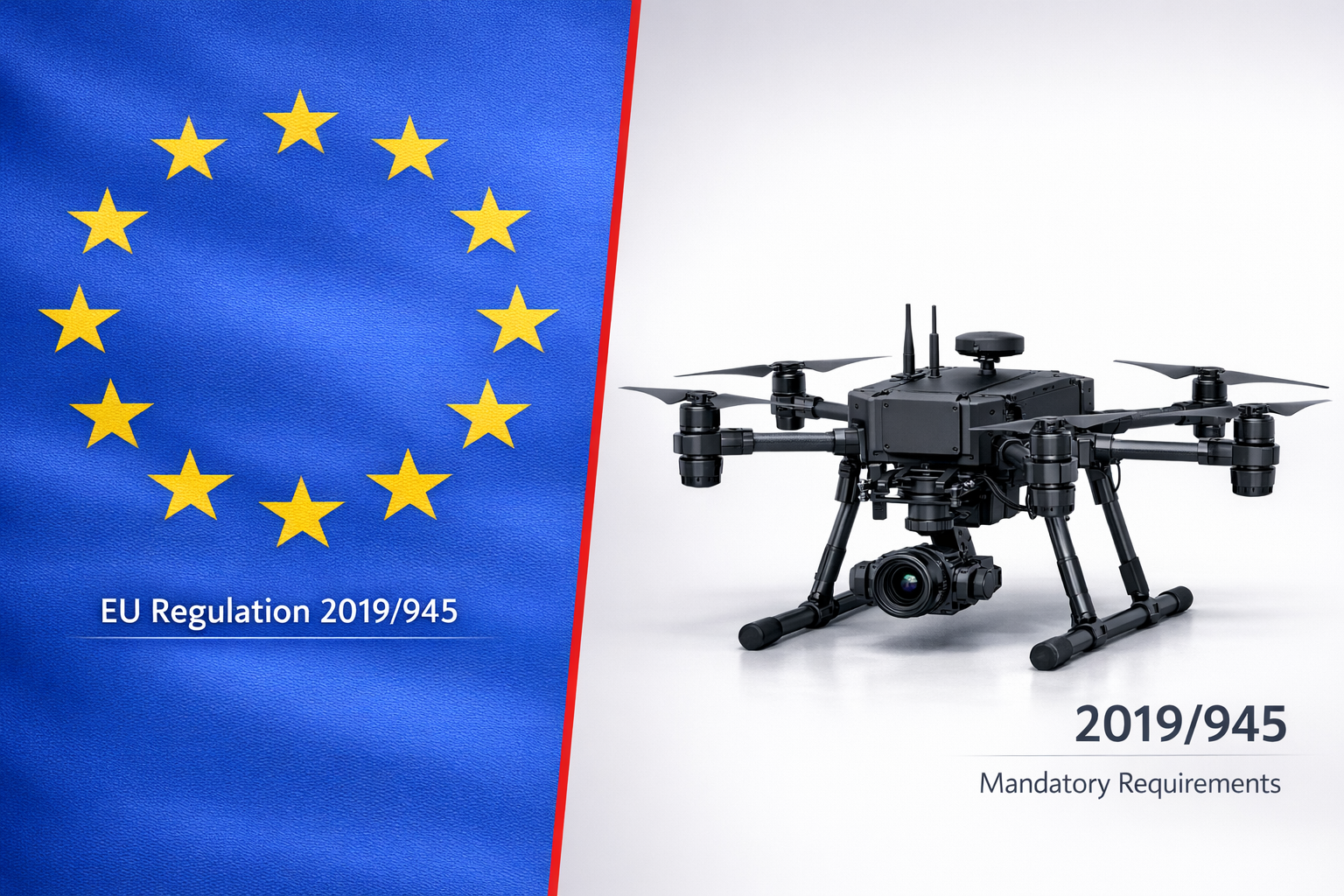
EU Regulation 2019/945 is the fundamental legal framework governing drone products for EU market access. The regulation establishes mandatory requirements for design, manufacture, and conformity assessment of unmanned aircraft systems, providing the legal basis for CE marking and market placement. Importantly, this regulation applies to the product itself, not to drone operations or remote pilot requirements, which are covered under separate Regulation 2019/947.
What Is EU Regulation 2019/945?
The EU drone regulations gave more importance from viewpoint of product safety and the certification processes since 2019. The EU Regulation 2019/945 describes the UAS’s conformity requirements, including CE marking and provisions related to third-country operators. The subject of the Regulation determines the requirements for the design and manufacture of unmanned aircraft systems and defines the type of UAS whose design, production and maintenance shall be subject to conformity assessment procedure or certification. It also establishes the requirements for the various UA classes, which determines the applicable technical, compliance, and certification procedures.
What Does EU Regulation 2019/945 Regulate in Practice?
In case of drones (UAS) EU delegated the (EU) 2019/945 Regulation, it lays down the requirements of conformity assessment and CE Marking processes and determines the method of the classification of UAs. The UA classes determine the technical, compliance, and certification requirements and the classes set out the path of conformity assessment procedure. Furthermore the 2019/945 Regulation describes the obligations of economic operators, particularly the obligations of drone manufacturers.
Difference Between Regulation and Standard
Standards outline detailed technical requirements and test methods but are not legally binding unless referenced in a regulation. Standards are intended to have a balanced representation of key industry stakeholders, such as government regulators, manufacturers, and practitioners. They focus on best practices to improve quality, safety, and interoperability.
Standards are regularly updated to evolve with technology, industry trends, and stakeholder input. They provide guidance for evaluating products, including pass criteria and verification methods. They are closely linked to the conformity assessment process.
Regulations are legally enforceable rules set by government bodies or authorities to ensure safety, health, environmental protection, and fair practices. Non-compliance with regulations can result in legal penalties, fines, or business shutdowns. Compliance with regulations is mandatory by law.
The intersection of standards and regulations lies in the fact that regulations set out the basic requirements, while standards provide the technical details and methods to meet those requirements.
How EN 4709 Relates to EU Regulation 2019/945
The Regulation (EU) 2019/945 lays down the essential requirements for the design and manufacture of drones (UAS) and it also lays down the legal basics of the type of the UAS and its conformity assessment process. In case of drones, the relevant standards (EN 4709 series) are based on the 2019/945 Regulation’s requirements.
The UAS conformity assessment procedure is based on the Regulation (EU) 2019/945, which is mandatory by law and the relevant applicable standards, the EN4709 standard series, which gives the technical methods of the verification process.
Once a Notified Body is involved in the conformity assessment process, like CerTrust Ltd. our testing and certification process is supported by the EN4709 standard series of the European Union.
Role of Conformity Assessment and Notified Bodies
The conformity assessment procedures under Regulation (EU) 2019/945 are the following:
Module A – Internal production control: For unmanned aircraft class 0, class 4, class 5, class 6 and add-ons only.
Module B + C – EU-type examination and conformity to type based on internal production control (for all classes).
Module H – Conformity based on full quality assurance (for all classes).
In cases of module B, C and H a Notified Body must be involved, furthermore in cases of UA Classes: C1, C2 and C3 mandatory to involve a Notified Body in the UAS conformity assessment procedure therefore either module B + C or module H shall be chosen.
FAQ: EU Regulation 2019/945
What is the scope of the Regulation (EU) 2019/945?
The scope of Delegated Regulation (EU) 2019/945 covers certification requirements, including CE marking and provisions related to third-country operators. Furthermore, the subject of the Regulation determines the requirements for the design and manufacture of unmanned aircraft systems and defines the type of UAS.
When is the Regulation (EU) 2019/945 applicable?
If you make UAS or accessories kit or remote identification add-ons available on the EU market under your name.
Summary
The Regulation (EU) 2019/945 is legally enforceable rule set by European Commission. It sets out the framework for the safe operation of civil drones in European airspace and lays down the requirements of conformity assessment process, CE Marking for drones and certification. It provides also the root for the relevant standards. Further guidance on CE Marking of drones and EN 4709 standards is available in our related articles.